
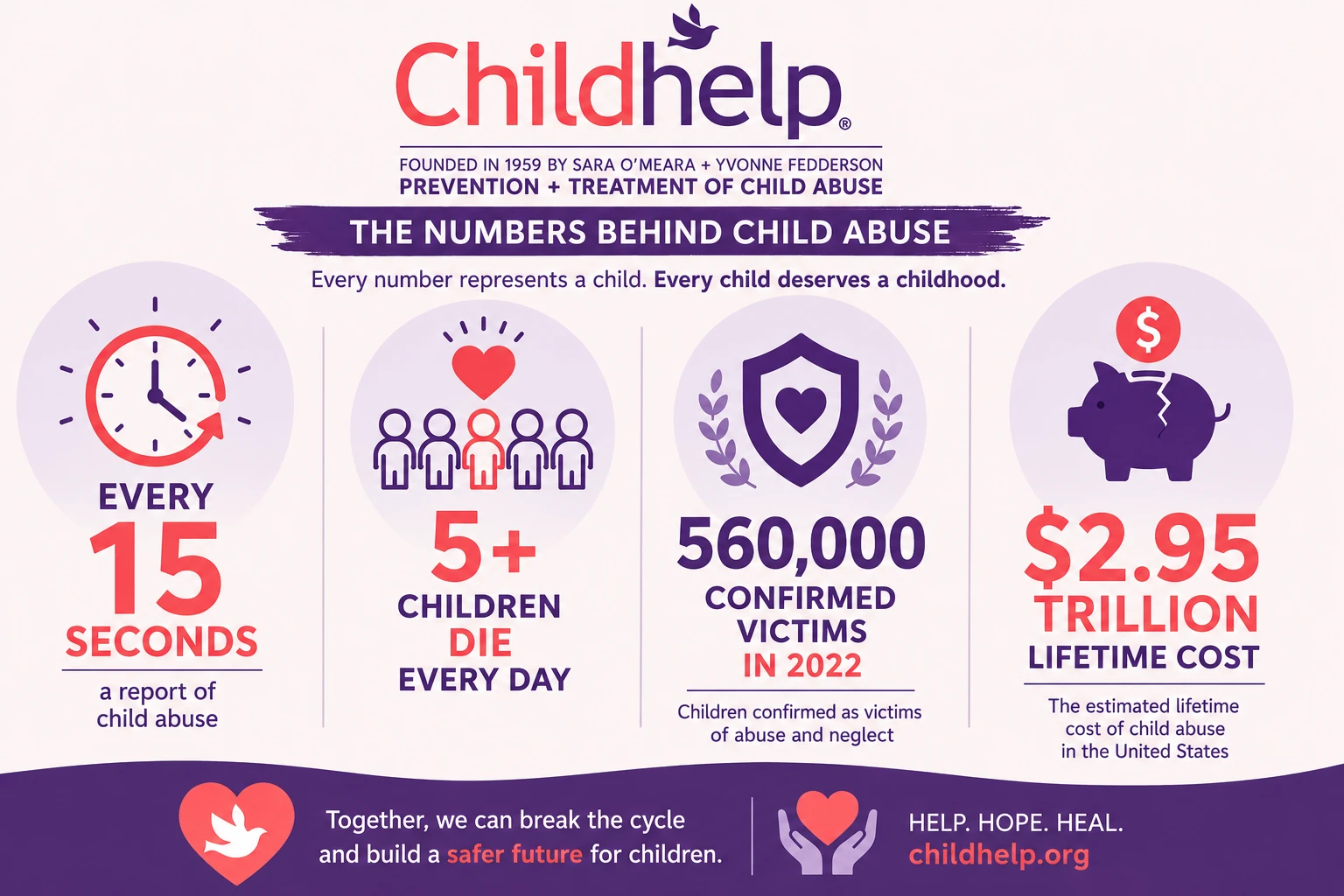
Every 15 seconds in America, someone makes a report of child abuse.
Meanwhile, more than five children die from it each day.
And every single day, ordinary people — teachers, neighbors, grandparents, strangers on the phone — decide to do something about it.
That last group is why we exist. Since 1959, Childhelp has believed something simple and unshakable: every child deserves to be safe, to be loved, and to grow up. As a result, we have built our entire organization around that belief, and over the past six decades it has changed more than 14 million lives.
However, to protect children, we have to look clearly at what threatens them. So let’s start there.
If you are hurting, or someone you love is hurting, please call the Childhelp National Child Abuse Hotline at 1-800-422-4453. The hotline is free, confidential, and open 24 hours a day, 7 days a week, in more than 170 languages. Our crisis counselors will listen, help you understand what you are facing, and connect you to the right next step. You do not need the right words. You only need to reach out.
Defining Child Abuse: What the Law Says, and What Love Demands
The federal Child Abuse Prevention and Treatment Act defines child abuse and neglect as any recent act, or failure to act, by a parent or caregiver that results in death, serious physical or emotional harm, sexual abuse, or exploitation — or that presents an imminent risk of serious harm.
That is the legal floor.
However, the legal definition only describes what child abuse is. It does not capture what child abuse does. Child abuse silences children. Furthermore, it teaches them that love is dangerous, that adults are not trustworthy, that their voices do not matter. In time, it rewrites the story a child tells themselves about who they are and what they deserve.
This is why understanding child abuse is not enough. We also have to act on what we understand.
Four elements show up in every legitimate definition of child abuse:
- It can be an action (hitting, sexual contact, cruelty with words).
- It can also be inaction (failing to feed, protect, supervise, or seek care).
- Someone in a position of trust commits it — a parent, guardian, relative, coach, teacher, clergy member, or anyone responsible for the child.
- It includes both actual harm and imminent risk of harm. A child does not have to suffer visible wounds for the conduct to qualify as abuse.
Every state builds on this federal floor with its own statutes. However, across all 50 states, the core categories remain the same.
The 4 Major Types of Child Abuse
There is no single picture of child abuse, there are four. In fact, most of the children we serve at Childhelp have experienced more than one.
1. Physical Abuse
Physical abuse happens when a caregiver inflicts non-accidental injury on a child. Hitting. Kicking. Shaking. Burning. Throwing. Any action that causes bodily harm, including discipline that crosses the line from teaching into wounding.
The caregiver does not have to intend the injury for the abuse to be real. For example, a caregiver who loses control and hurts a child has still committed abuse, even if the regret comes after.
Warning signs of physical abuse include:
- Unexplained bruises, welts, burns, or fractures
- Injuries shaped like belts, hands, cords, or other objects
- Marks on places that rarely get hurt accidentally — back, buttocks, thighs
- Fear of going home, or fear of a specific adult
- Flinching at sudden movements
- Long sleeves and pants worn in hot weather to cover injuries
2. Sexual Abuse
Sexual abuse happens when an adult or older child uses a younger child for sexual purposes. It includes touching, penetration, exposure to sexual material, exploitation through trafficking, and the production of child sexual abuse imagery.
A child cannot consent. Not ever. The responsibility belongs entirely to the perpetrator, every time, regardless of the child’s age, behavior, or what the perpetrator told themselves to make it acceptable.
In addition, here is the truth most parents are not ready to hear: the danger is rarely a stranger. In fact, more than 90 percent of children who experience sexual abuse know their abuser. The perpetrator is almost always someone the family trusted.
Warning signs of sexual abuse include:
- Age-inappropriate sexual knowledge or behavior
- Sudden withdrawal, anxiety, or depression
- Nightmares or new fear of being alone with a specific person
- Regression to younger behaviors like bedwetting or thumb-sucking
- Avoiding changing clothes, bathing, or specific activities
- Physical symptoms such as pain or discomfort
For this exact reason, Childhelp created Speak Up Be Safe — to give children the language and confidence to recognize what is happening and to tell a trusted adult.
3. Emotional Abuse (Psychological Maltreatment)
Emotional abuse is a pattern of behavior that damages a child’s sense of who they are. Constant criticism. Threats. Rejection. Name-calling. Public shaming. Being ignored. Witnessing violence against someone they love.
Because it leaves no bruises, emotional abuse is the hardest type to see — and the most pervasive. Indeed, researchers now recognize that emotional harm weaves into almost every other form of abuse. When a caregiver hits a child, they are also telling them something. Similarly, when someone sexually abuses a child, they are also training the child to doubt themselves.
Warning signs of emotional abuse include:
- Extremes in behavior — overly compliant or extremely demanding
- Delayed emotional or social development
- Loss of previously mastered milestones
- Depression, anxiety, or low self-esteem
- Self-harm or expressed thoughts of suicide
- A child who reports feeling no connection to their parent or caregiver
4. Neglect
Neglect is the failure to provide for a child’s basic needs. It is the most common form of child maltreatment in the United States. Furthermore, it is the form most often misunderstood.
Neglect comes in four forms:
- Physical neglect: lack of food, clothing, shelter, hygiene, or supervision appropriate for the child’s age
- Medical neglect: failure to provide necessary medical or mental health care
- Educational neglect: failure to enroll a child in school or address chronic absenteeism
- Emotional neglect: failure to provide affection and attention, or allowing a child to use drugs or alcohol
Here is what neglect is not: poverty. Federal and state laws are clear. A family that cannot afford resources is not, by that fact alone, a neglectful family. Specifically, neglect occurs when a caregiver has the means to provide and chooses not to, or refuses available help. The distinction matters. Otherwise, we punish struggling families instead of supporting them.
Warning signs of neglect include:
- Consistently dirty clothes, poor hygiene, or strong body odor
- Hunger, hoarding, or stealing food
- Untreated medical or dental problems
- Frequent absences from school
- Clothing inappropriate for the weather
- Being left alone or to care for other young children
The Scale of the Problem: Child Abuse in America
We cannot solve a problem we will not see. So look closely.
- In 2022, state agencies identified nearly 560,000 confirmed child victims of abuse and neglect.
- Each year, child protection agencies receive more than 4 million referrals, involving more than 7.5 million children.
- Furthermore, more than 5 children die every day in the United States as a result of abuse or neglect — about 1,990 children in 2022 alone.
- In addition, 70 percent of the children who die from abuse or neglect are three years old or younger.
- Approximately 80 percent of child maltreatment fatalities involve at least one parent as the perpetrator.
- The lifetime financial cost of cases investigated in a single year reaches an estimated $2.95 trillion.
These are not just numbers. They are the reason a hotline counselor stays on the line at 3 a.m. Likewise, they are why a foster family says yes one more time. Indeed, donors give because of them. Behind every number, a child’s entire future hangs on what we do — or fail to do.
You can see Childhelp’s full data, with sources, on our Child Abuse Statistics page.
How Child Abuse Echoes: The Lifelong Effects on Survivors

Child abuse does not end when the abuse ends.
Decades of research — most notably the landmark Adverse Childhood Experiences study by the CDC — show that maltreatment in childhood reshapes the body, the brain, and the future. As a result, survivors face elevated rates of depression, anxiety, PTSD, substance use, chronic illness, and suicide. Individuals who report six or more adverse childhood experiences also have an average life expectancy two decades shorter than those who report none.
Read that again. Two decades.
However, here is the part that should change how we think about every dollar spent on prevention and healing: the effects of child abuse are not destiny. With trauma-informed care, stable relationships, and access to resources, survivors heal. Children who reach safety early do not just survive — they go on to build full, generous, meaningful lives. Indeed, we have watched it happen in our residential treatment village thousands of times.
The earlier we reach a child, the more of their life we get to give back to them.
Why Child Abuse Happens: Risk Factors and Protective Factors
No single thing causes child abuse. Instead, it happens when stressors in a family pile up faster than the family’s protective factors can absorb them.
Common risk factors include:
- Caregiver substance use or untreated mental illness
- Domestic violence in the home
- Social isolation and lack of support networks
- High household stress, including financial strain
- A caregiver who experienced abuse as a child and never received help
Protective factors, on the other hand, soften and even prevent harm. Strong parent-child bonds. Social connections. Parenting knowledge. Concrete support during hard times. A child’s own social and emotional skills.
This is why Childhelp’s prevention work matters so much. For example, Speak Up Be Safe reaches children in Pre-K through 12th grade with age-appropriate education. Similarly, Connect to Protect Kids equips the adults around them. Every classroom we reach becomes a wall of protective factors going up.
How to Report Suspected Child Abuse
If you suspect a child is being harmed, you do not need certainty. You need only a reasonable concern. From there, trained professionals will take it.
Reports go to your state’s child welfare system. Here is how to make one:
- Call 911 if a child is in immediate danger. Law enforcement responds faster than any other system.
- Call your state or county Child Protective Services agency. Every state has a designated CPS reporting line that takes intake, opens cases, and investigates concerns. This is where formal reports are filed.
- Make a report online through your state’s CPS website where available.
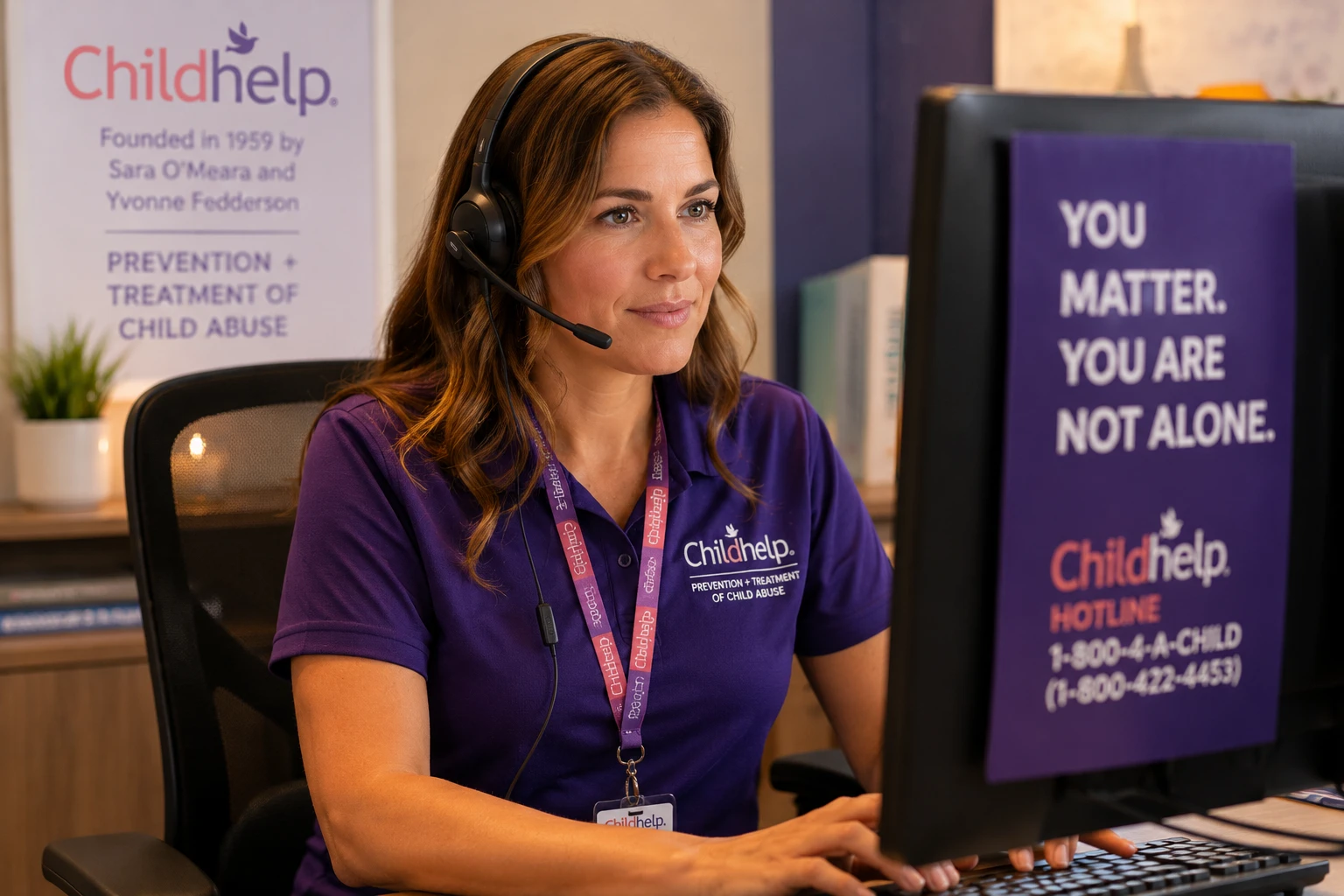
If you need someone to talk to before you act — if you are unsure of what you are seeing, afraid, or simply need to think it through with a trained counselor — call the Childhelp National Child Abuse Hotline at 1-800-422-4453. Available 24/7, in more than 170 languages, by call, text, or chat. Our crisis counselors do not file reports themselves. However, they will listen, help you understand what you are facing, and connect you to your state’s reporting system and other local resources.
Most professionals who work with children — teachers, doctors, nurses, clergy, coaches, social workers, childcare providers — serve as mandated reporters. The law requires them to report. However, the law also protects anyone who reports in good faith, even if the concern turns out to be unfounded.
You will not cause a loving family to lose their child. But you may help rescue a child from a harmful one.
How You Can Help End Child Abuse
You may not be a hotline counselor, a foster parent, or be able to open an advocacy center.
But you can do something. And every something matters.
Here is what helps:
- Take 15 seconds to help. Our 15 Seconds campaign makes it possible to protect a child in less time than it takes to read this sentence.
- Donate. Childhelp runs almost entirely on gifts from people who believe what we believe. Your gift staffs the hotline, fills the residential village, trains the prevention educators, and keeps the lights on at our advocacy centers. Give a one-time or monthly gift here.
- Give in kind. Our Gift Catalog lets you fund specific needs — a therapy session, a backpack of school supplies, a night of safe shelter.
- Plan a legacy gift. A legacy gift ensures your values continue protecting children long after you are gone.
- Share what you learned today. Most child abuse continues because the adults around the child do not recognize it. Forward this article. Talk about it at the dinner table. Indeed, the conversations save lives.
- Get your workplace involved. Many employers will match your donation, doubling your impact at no extra cost.
We do not ask people to give because we need money. We ask people to give because children need rescuing, and the rescue costs money. Therefore, every dollar becomes a small act of belief that the next child does not have to suffer the way the last one did.
Frequently Asked Questions About Child Abuse
What is considered child abuse?
Child abuse means any act, or failure to act, by a parent or caregiver that causes serious physical injury, emotional harm, sexual exploitation, or risk of harm to a child. Specifically, it falls into four categories: physical abuse, sexual abuse, emotional abuse, and neglect.
What is the most common type of child abuse?
Neglect is the most common form, accounting for the majority of substantiated child maltreatment cases in the United States. For example, neglect includes a caregiver’s failure to provide adequate food, shelter, medical care, supervision, or emotional support.
What is the difference between discipline and child abuse?
Discipline teaches and guides. It uses age-appropriate consequences and respects the child’s dignity. Child abuse, however, harms — physically, emotionally, or sexually — and stems from the adult’s loss of control, not the child’s growth. When discipline leaves marks, causes injury, or terrifies a child, it has crossed into abuse.
Who do I call to report child abuse?
To file a formal report, contact your state or county Child Protective Services agency. Every state has a designated CPS line that takes reports and opens investigations. For emergencies where a child faces immediate danger, call 911. If you need someone to help you think it through first, the Childhelp National Child Abuse Hotline at 1-800-422-4453 is available 24/7. Our crisis counselors can help you understand the situation and connect you to your state’s reporting line.
Can I report child abuse anonymously?
Yes. In most states, you can report anonymously. Furthermore, the law protects reporters who act in good faith from civil and criminal liability, even if investigators ultimately do not substantiate the abuse.
What happens after I report child abuse?
Child Protective Services reviews the report and decides whether to investigate. If they investigate, a caseworker assesses the child’s safety, interviews the family, and determines what services or interventions the family needs. Agencies usually do not share the outcome with reporters, in order to protect the family’s privacy.
How does child abuse affect a child long-term?
Child abuse affects brain development, mental health, physical health, relationships, and lifelong achievement. However, with early intervention, trauma-informed care, and stable support, survivors heal. Healing is not only possible — it is the rule, not the exception, when the right help arrives in time.
Is poverty considered child neglect?
No. Federal law and every state statute are clear that a family’s inability to afford basic resources, by itself, does not amount to neglect. Specifically, neglect occurs when a caregiver has the means to provide or refuses available help, and the child suffers as a result.
At Childhelp, All Who Enter Here Will Find Love
We started in 1959 with two young women on a goodwill tour who could not walk past 11 children sleeping on a street in Tokyo. They brought them home. Then they brought home more. Eventually, they built a movement.
More than six decades later, we are still doing the same thing on a far bigger scale: refusing to walk past.
Every child who calls our hotline, every child who walks into one of our advocacy centers, every child who finds their way to The Village — they all hear the same promise. All who enter here will find love.
You can make that promise possible for the next child.
Give today. Or call 1-800-422-4453 if you need to talk to someone right now. Either way, you are not alone, and neither is the child you are worried about.